01 / Label
Naming binds
A name draws a perimeter around unstable material. It can protect a record—or force it into the wrong identity.
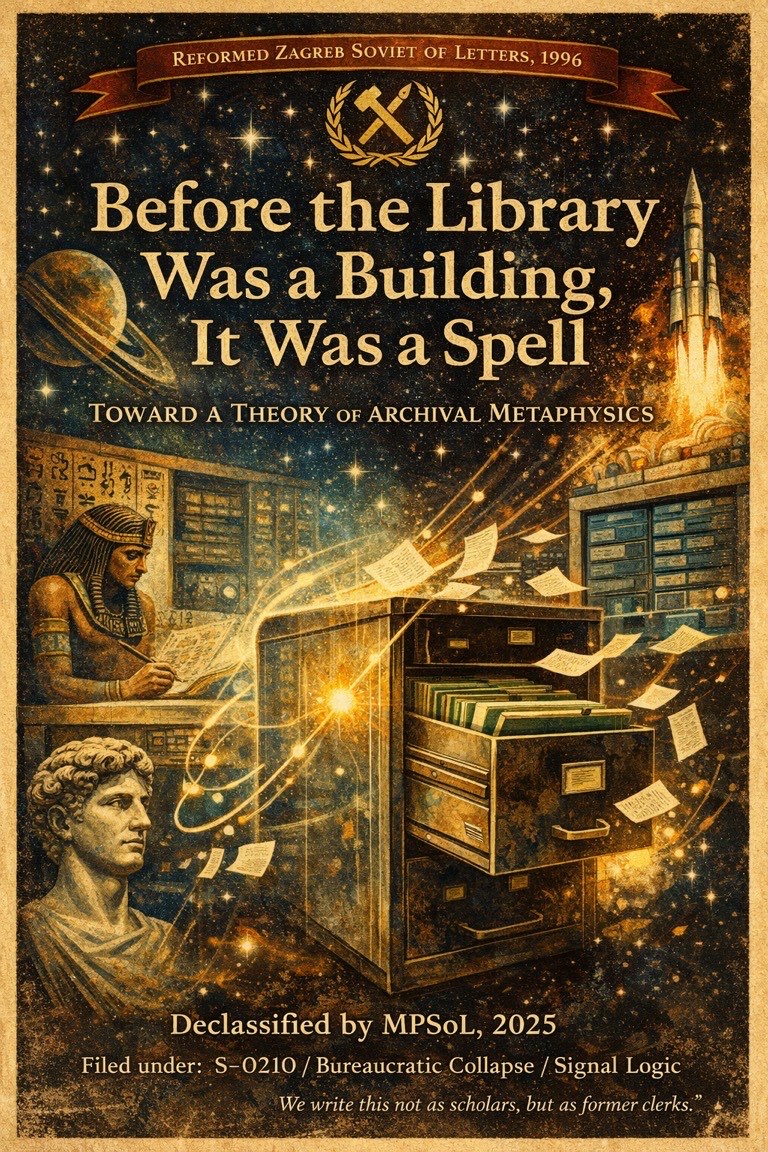
The archive is not presented as a passive storehouse. It is an active machine that decides what can be found, related, remembered, and carried forward. The book begins with clay tokens and temple ledgers, passes through Dewey, metadata, automation, and institutional decay, then returns to the hand of the clerk.
A name draws a perimeter around unstable material. It can protect a record—or force it into the wrong identity.
Storage without intention merely delays loss. Filing gives the record a position inside a larger symbolic order.
A careful reference builds a bridge. Too many links dissolve the interior until every drawer points elsewhere.
Removal does not become neutral because it is procedural. What disappears still shapes the field around it.
A wrong category can make a person, event, or history inaccessible without ever technically erasing it.
The 42-page memorandum progresses from the invention of the record to the final closing of the drawer. Each movement tests whether order is care, coercion, or both.
Every retained record extends one voice into the future while another may be allowed to disappear.
Classification encodes a worldview. Familiarity can make an inherited bias look like neutral architecture.
“Preserve what is fragile because it is fragile.” The archive must remember for the future, not in spite of it.
The complete archive reading edition is available now for full inspection, annotation, and retrieval.
Open the complete archiveThe active 42-page A5 perfect-bound edition: a compact object for archivists, librarians, clerks, systems thinkers, and anyone who has ever inherited an impossible folder hierarchy.
The operational companion: memory stabilization, incident classification, symbolic re-indexing, and responsible custody of recovered material.
Structural memory systems for carrying patterns through cultural collapse, technical failure, linguistic drift, and missing explanation.
A field workbook for reducing a project to one authorized, observable page that can be started, witnessed, closed, and reopened cleanly.