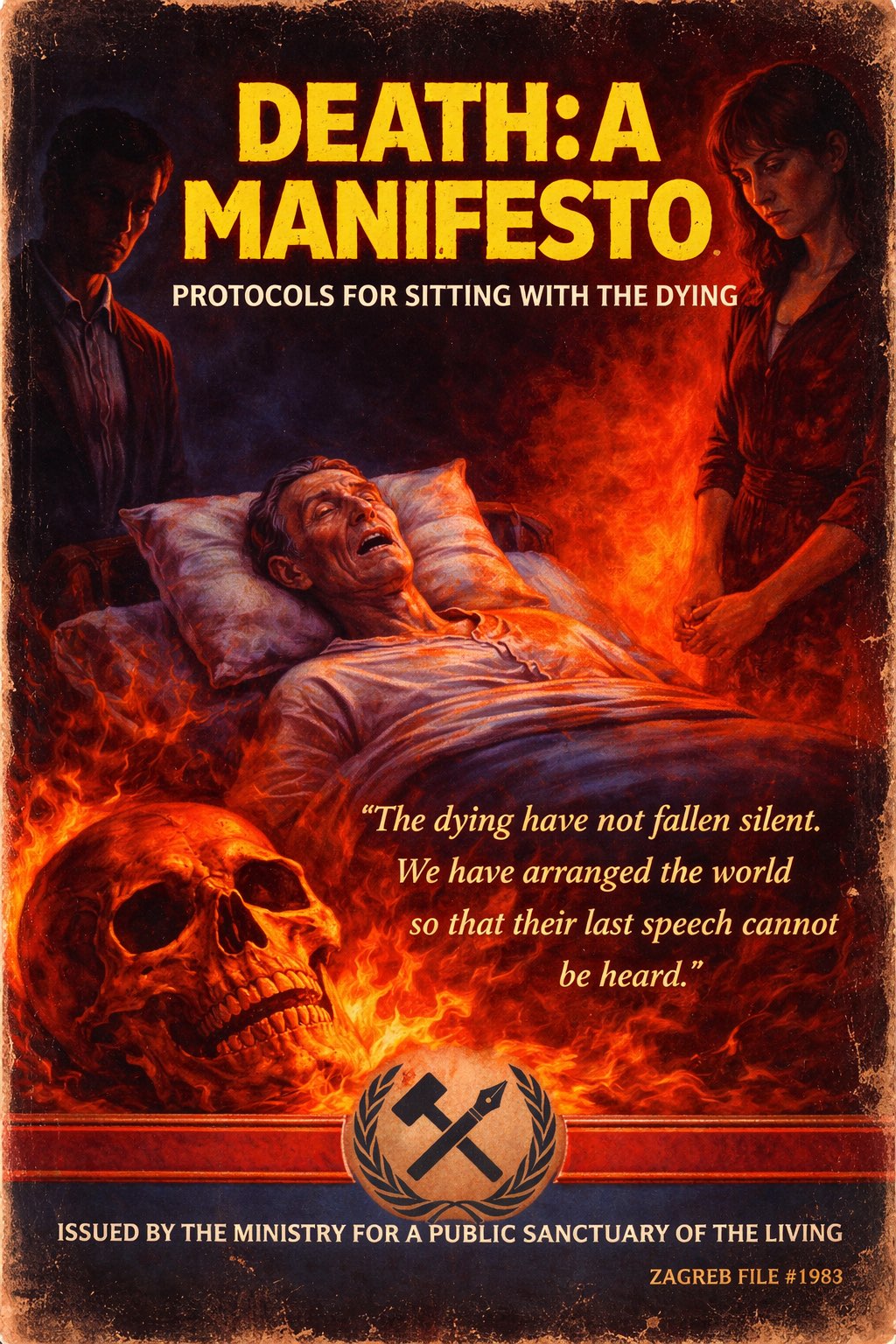
Not devotional. Not clinical. Not therapeutic branding. This document is written for people who have watched institutional language shrink around an actual deathbed.
It argues that the dying remain persons to the end: still speaking, still perceiving, still able to bind the living to obligations larger than comfort-management.
15-part manifesto sequence
Appendix: Minimal Protocol for Sitting with the Dying
Moral distinction: comfort vs flattening
Civic argument for a public art of dying
Threshold Record
Public Argument — What This Is
Death has been managed. The dying have not been heard.
This is a short, forceful case for recovering bedside literacy: the ordinary human ability to sit, listen, and remain steady when a dying person’s speech no longer obeys the room.
Part cultural criticism, part bedside declaration, and part civic memorandum, the manifesto refuses both easy mysticism and automatic dismissal. Its demand is simpler: the dying remain persons, and their final speech still belongs to the human record.
01
Against the Thin Death
Comfort and pain relief can be merciful. The argument is against turning calm, efficiency, and institutional smoothness into substitutes for witness.
02
For Threshold Speech
The text asks readers not to correct strange end-of-life speech too quickly—and not to canonize every utterance. Attention must remain sober, open, and disciplined.
03
Rights and Duties
The dying retain the right to silence, unfamiliar speech, familiar objects, and unhurried company. The living inherit duties of steadiness, restraint, and return.
04
A Public Art of Dying
The manifesto argues that medicine is indispensable but not sufficient. Ordinary people also need durable forms for accompaniment, ritual, ambiguity, and witness.
Scope Notice — Read Before Use
A cultural argument. Not clinical instruction.
This booklet does not replace medical, hospice, palliative-care, mental-health, legal, or spiritual guidance. It does not advise withholding pain relief or necessary treatment. Its bedside protocol concerns posture, attention, speech, and the arrangement of the room; clinical decisions remain with the dying person and their qualified care team.
The text’s own position is explicit: medicine is indispensable, but no single profession can carry the entire human meaning of death.
Contents — Fifteen Sections + Appendix
Seventeen pages. No ornamental chapter.
The argument moves from cultural diagnosis to bedside form, then ends with a one-paragraph minimal protocol for sitting with the dying.
01
Why We Are Forced to Write
02
Against the Thin Death
03
What the Dying Still Say
04
How a Civilization Forgets How to Die
05
Cruelty in the Name of Calm
06
Oakland Notes: The Poor Die Publicly
07
Berkeley Notes: Right Instinct, Weak Form
08
Big Sur Fragment: On Sitting with the Dying
09
On the Room
10
The Dying Are Not Delirium Machines
11
The Rights of the Dying
12
The Duties of the Living
13
Against the Professional Monopoly on Death
14
Toward a Public Art of Dying
15
Declaration
A
Minimal Protocol for Sitting with the Dying
“The dying have not abandoned us. We have abandoned them in precisely the moment when they become most difficult to hear.”
— DEATH: A MANIFESTO, Declaration 76
Acquisition Routes
Read one. Carry one. Circulate five.
The complete document remains free. The single edition is for a desk, shelf, bag, or bedside library. The five-copy allocation exists because a public document does more work when it moves between hands.
Archive Route
Read the Complete Manifesto
$0
Open the full 17-page PDF, including all fifteen sections and the minimal sitting protocol. Read before deciding whether to acquire print copies.
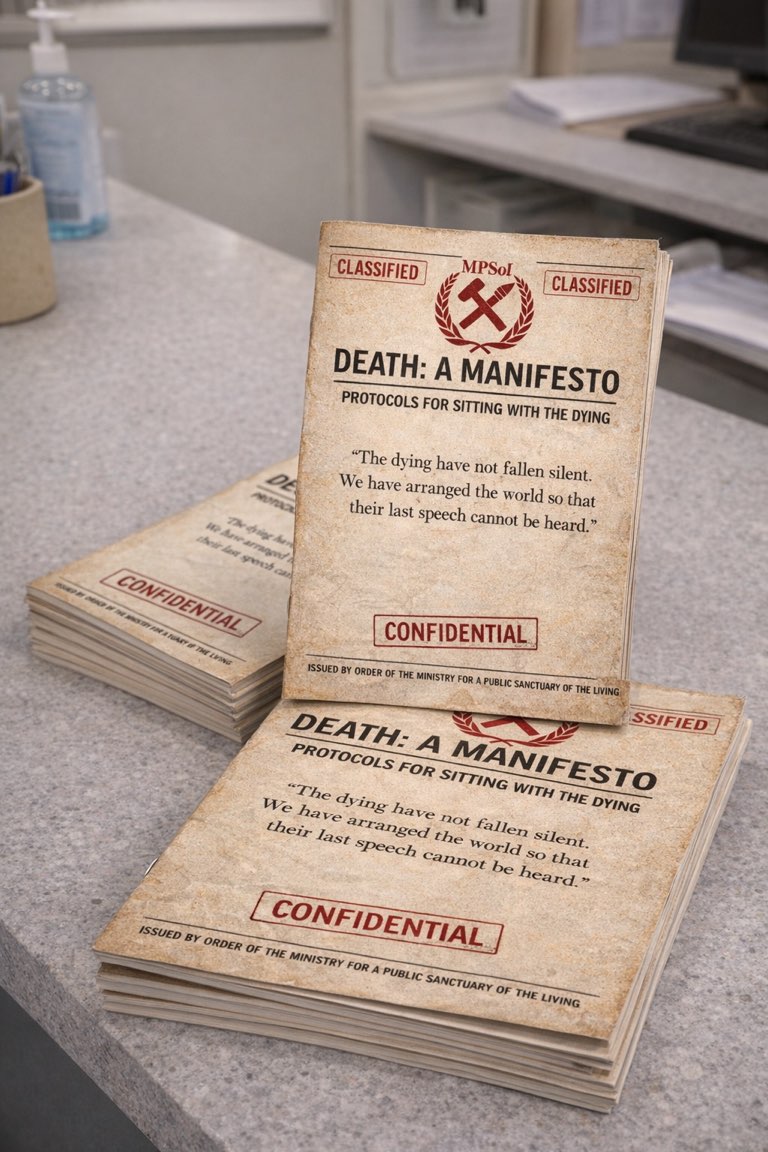
One A5 saddle-stitched copy for personal reading, repeated reference, or a room where the available language has become too small.
Circulation Route — Best Value
Distribute Five Copies
$45
$9 each · save $40 against five singles
Five physical copies for friends, caregivers, waiting rooms, chapels, desks, or any small circle prepared to argue about how the dying should be heard.