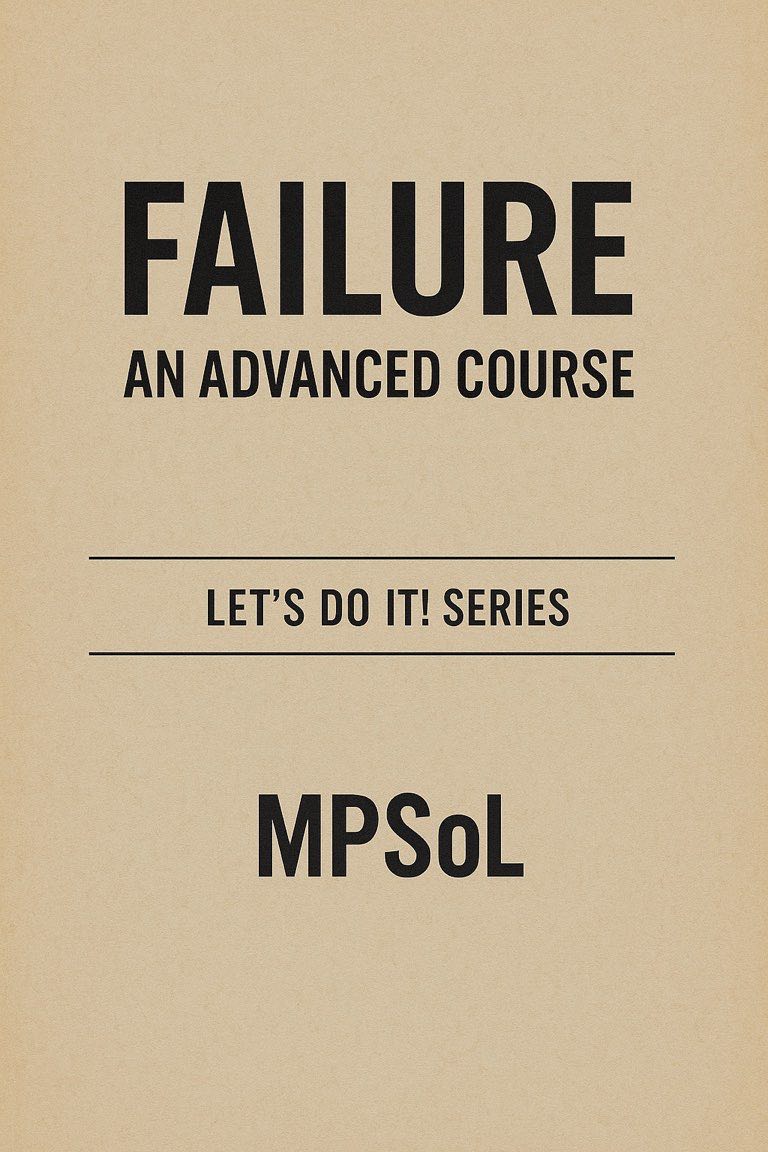
Compiler Orientation Record / Human-Scale Breakdown
Compiler Orientation Packet / Stage 03
The human consequences of symbolic systems.
The first two onboarding books establish architecture and recursive metaphysics. Failure brings the sequence down to the person who hesitates, sabotages, collapses, narrates the collapse, and must still decide what to do next.
Failure is not identity. It is choreography.
The course refuses both motivational triumph and permanent defeat. Its premise is procedural: failure has cues, rituals, rewards, bodily signatures, protective functions, and recurrence. What has been trained can be observed. What can be observed can be interrupted. What can be interrupted can be redirected.
Locate self-hatred at the moment before motion, name the feedback loop, and break hesitation’s timing by moving before alignment arrives.
Chapter 02
Anatomy of a Pattern
Recognize initiation cues, familiar pain, tiny concessions, and the fantasy that one cinematic turning point will do the work of repetition.
Chapter 03
The Strategies of Almost
Expose planning as displacement, imagined alternate lives as narcotic, unfinished bridges as fear of the middle, and open doors as protected excuses.
Chapter 04
Emotional Precision
Name hurt accurately, leave dead structures unfinished, stop laundering emotion, practice refusal, and let obsolete masks collapse.
Chapter 05
The Comfort of Collapse
See how failure offers familiarity, rehearses old wounds, shields identity from growth, and quietly reorganizes everyone around the absence.
Chapter 06
Repurpose the Machinery
Hijack the same imagination, timing, resistance, deflection, and performance once used for sabotage; redirect the machinery instead of discarding it.
Chapter 07
Designing Your Days
Replace plans with containers, motivation with durable structure, mastery with momentum, and punitive discipline with rhythms that pull the Operator back.
Chapter 08
The Body of the Pattern
Trace the machinery backward through posture, trigger, reward, and repetition; train interruption until the pattern’s apparent solidity becomes hollow.
Chapter 09
The Return Loop
Claim leverage without shame, rebuild for function, recover without applause, and measure change by the refusal to bow automatically to error’s rhythm.
Chapter 10
The Recurrence
Return to the classroom knowingly. The course does not promise mastery; it teaches the difference between failure that is seen and failure that consumes.
Four operational replacements
Do not wait to feel better. Change the mechanism.
Replacement 01
Interruption Over Insight
Notice the old pattern without debating it, pause its completion, and take any action that contradicts its expected direction.
Replacement 02
Containers Over Plans
Make structures that remain available after shame, boredom, missed days, and low motivation. Show up badly; preserve the return route.
Replacement 03
Momentum Over Mastery
One paragraph, one movement, one awkward message: the immediate task is not greatness but the destruction of stasis.
Replacement 04
Recurrence Over Perfection
Expect the loop to return. Catch it earlier, fail with awareness, re-enter without spectacle, and let repetition become instruction.
Course boundary: this document is intentionally direct, but it is not a miracle cure, clinical diagnosis, or promise of success. It offers pattern language and repeatable interruption procedures. The reader is not asked to become flawless—only less hypnotized by the collapse.
Choose the transmission
Read the course. Keep the working copy.
Archive route / Immediate access
Read the complete free PDF
$0
Inspect the full 34-page curriculum: the failure loop, emotional precision, protective collapse, machinery reversal, daily containers, bodily cues, and recurrence.