Section I
The Resonant Operant
Moves from absorption to emission: baseline breath, quiet cadence, mutual arrival, persistence after presence, and the discipline of stepping back when another center can carry the room.
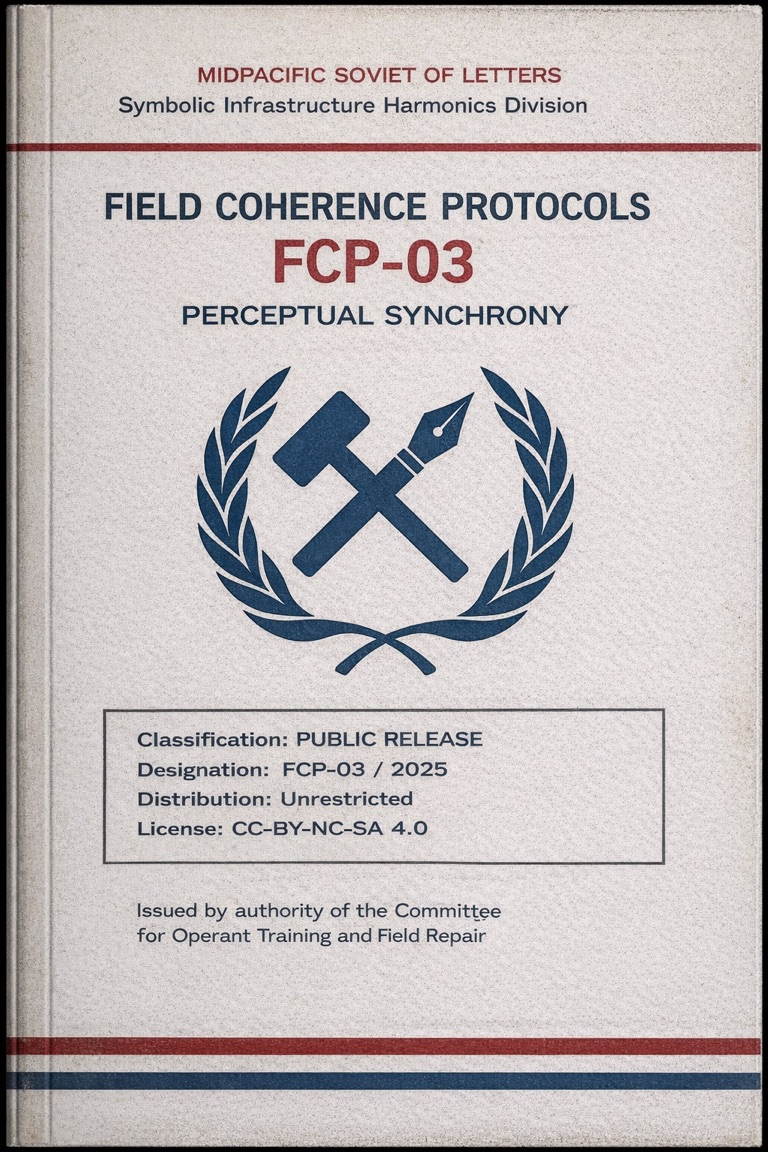
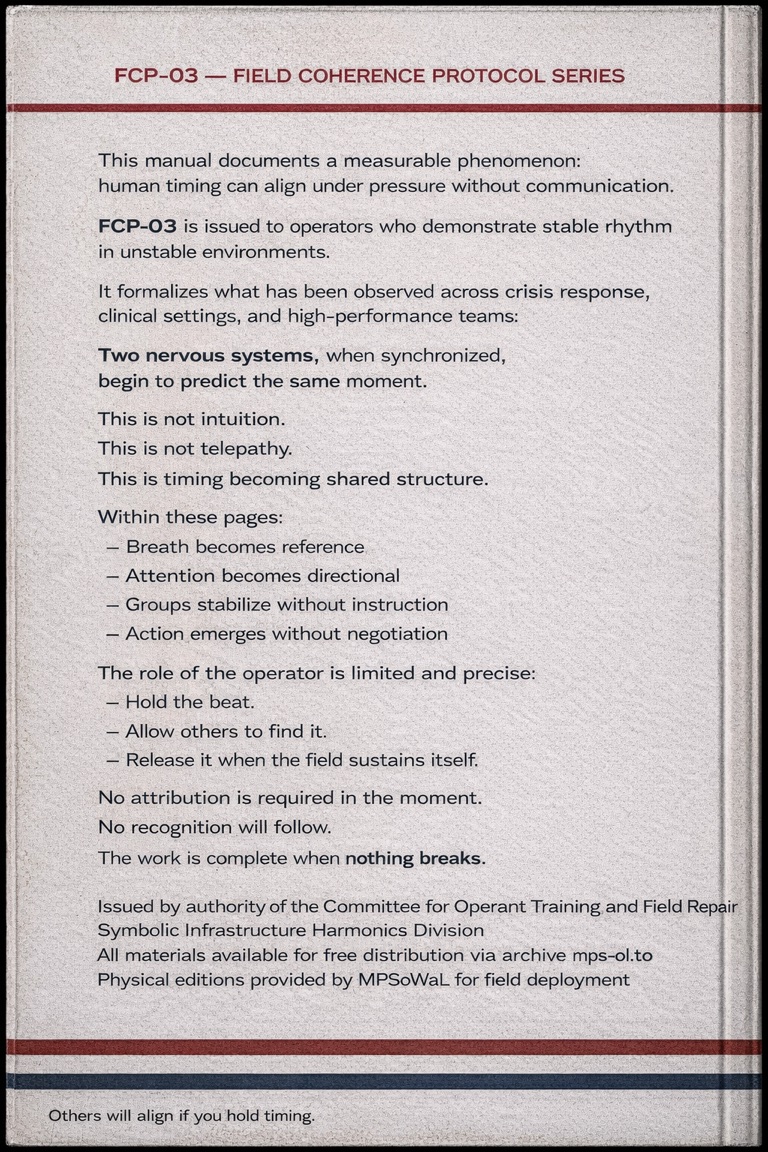
FCP-03 begins where the earlier protocols leave the operator: able to return to a chosen rhythm under pressure. Volume 03 changes the direction of travel. Breath, pause, gaze, posture, and movement become a stable temporal reference that another person—or a group—can find without formal instruction.
The manual calls this Simultaneous Operancy. Its governing claim is not that one person commands the room, but that predictable timing reduces surprise and makes coordination easier to join.
Return to the beat after stress, urgency, contact, or distraction rather than pretending drift never occurred.
Offer a consistent pace without performing calm, forcing imitation, or treating influence as leadership property.
Read pre-intent, breath changes, pauses, gaze, and shared movement as early structure—not privileged access to another person.
Release the field when it holds itself, follow a better pace when it arrives, and preserve the right of every participant to diverge.
Moves from absorption to emission: baseline breath, quiet cadence, mutual arrival, persistence after presence, and the discipline of stepping back when another center can carry the room.
Trains drift and return, the difference between urgency and importance, one-person footholds, pace handoff, and steadiness through direct contact or interference.
Expands from shared awareness into silent coordination, three-point structures, work beyond direct visual contact, field recoil, and release before influence becomes dependence.
Studies pre-intent, eye patterns, anchored gesture, the pressure carried by silence, and clean stop-signals that end action without introducing alarm.
Builds shared temporal models from breath, pause, and cooperative movement, then interrupts the fantasy of mastery with a boundary: connection is not ownership.
Extends the model into ghost beats, separate rooms, distant check-ins, and timing that persists after contact—before teaching graceful termination rather than attachment.
Distinguishes alignment from manipulation, contact from capture, assistance from diagnosis, privacy from collection, and shared will from control.
FCP-03 is most persuasive where it stays close to ordinary coordination: people match breath and pace, read pre-movement cues, share attention, predict familiar partners, and co-regulate under stress. Its appendices place those observations beside nonverbal communication, predictive processing, interpersonal entrainment, performance practice, ritual rhythm, and dyadic regulation.
The book deliberately pushes beyond those observable mechanisms into remote synchrony: sensing arrivals through walls, distant check-in beats, and shared timing without contact or temporal confirmation. Those extensions belong to the manual’s field doctrine. The research lineages named in the appendices do not, by themselves, establish telepathy or non-local communication.
That distinction does not diminish the book. It tells you what kind of attention each section deserves. The grounded sections ask for practice and observation. The remote sections ask for curiosity, restraint, and a cleaner standard of evidence. Where the text enters therapy, crisis, patients, children, or unequal authority, its own ethics point the way: a power difference narrows what can be responsibly attempted.
FCP-03 spends its final operational section and an entire print-out appendix preventing synchrony from becoming capture. The manual repeatedly gives autonomy precedence over successful alignment.
If the operator cannot identify who benefits—or notices a hunger for control—the instruction is to reduce influence to zero and step back.
Participation permits cautious co-authorship. Discomfort reduces the field. Fear, retreat, or active escape ends the attempt immediately.
Separate priorities, unmatched pauses, divergent movement, refusal, and another person taking the lead are not failures of synchrony.
The operator does not collect inferred secrets, expose vulnerability, or act as though subtle perception creates permission to know.
Withdrawal is not punishment. Eye anchor softens, attention returns to the body, and the other person receives full ownership of their pace.
The book prohibits deliberate influence where children, distressed patients, evaluated students, subordinates, fear, or romantic ambiguity make refusal unequal.
Appendix C indexes thirty exercises across projection, pressure, group synchrony, silent signaling, perceptual merging, and remote synchrony. It then organizes them into three loads: a ten-minute daily maintenance route, a fifteen-to-twenty-minute development route, and a structured operator practice with morning, midday, evening, weekly, and monthly review.
Co-regulation, human factors, predictive cognition, performance, martial timing, crisis work, ritual, attachment, and collective rhythm.
Autonomic rhythm, respiratory sinus arrhythmia, motor simulation, predictive processing, phase-locking, and interpersonal entrainment.
Thirty named drills, three training schedules, pair practice, challenge scenarios, and a monthly ethics-and-boundary audit.
STOP checklist, consent markers, autonomy routines, intent audit, disengagement, emotional boundaries, remote etiquette, and directives.
Reading routes through breath, predictive minds, nonverbal signals, synchrony research, ritual, dyadic interaction, teams, and FCP-04.
Volume 02 trains one operator to establish and release a small containment geometry. FCP-03 turns that private steadiness toward shared timing.
Return to FCP-02The next protocol shifts from synchronized people to orientation when ordinary vision becomes unreliable, extending attention across other sensory routes.
Proceed to FCP-04Stay connected.— FCP-03 / Maintaining Boundary
Stay separate.
The MPSoL archive serves the complete manual in its 145-page archive layout. The text is repaginated from the current physical edition rather than presented as an identical print file.
Open the archive editionThe active perfect-bound edition: seven operational sections, afterword, five appendices, thirty-drill index, training schedules, ethics cards, and further-reading routes.