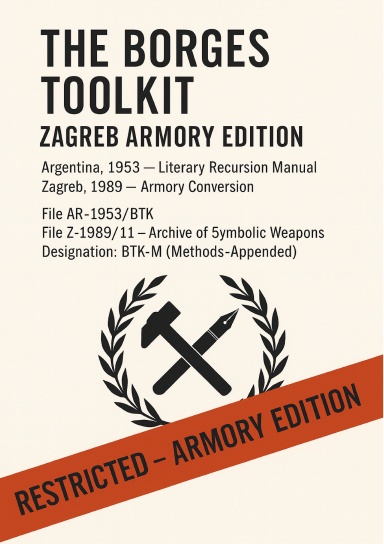
Zagreb Armory Edition (v3.2.2) / Literature to Weapon
A canonical MPSoL work. Eight narrative engines are extracted from literature, tested against the reader, and converted into an armory document on how stories replace reality.
This is not literary theory. It is literary systems engineering.
First the machinery is named. Then the machinery is turned outward.
Canonical Armory Record / Literature → Weapon
Foundational MPSoL canon
The book that names the narrative machinery.
Within the MPSoL archive, The Borges Toolkit is a canonical work: the point where fiction stops being an object of admiration and becomes an operational system that can be isolated, tested, deployed, and resisted.
Not a book about Borges. A manual extracted from him.
The Toolkit begins from a pre-history of postmodernism: Cervantes makes authorship contest itself, Melville builds a system that consumes what it pursues, and Borges compresses those instabilities into portable devices. The result is literary systems engineering—a manual for recognizing what stories do before deciding what they mean.
The hidden trinity
Three writers. One recurring disturbance.
1605 / 1615
Cervantes
Don Quixote turns counterfeit sequels, fictional authorship, and reader awareness into a contested narrative system that rewrites itself while running.
1851
Melville
Moby-Dick makes the Pequod an epistemological engine: a closed system that burns the object of its pursuit to continue pursuing it.
1930s onward
Borges
Borges miniaturizes the machinery into proofs: the library, lottery, labyrinth, double, invented encyclopedia, and text that alters under a new author.
Eight deployable narrative engines
The tricks become tools. The reader becomes armed.
Engine 01
The Tlön Protocol
Build a fiction with such documentary completeness that consensus reality begins to yield to its internal coherence.
Engine 02
Structural Reorientation
Rotate the reader’s interpretive grid until the inherited frame becomes unusable and only the new structure explains the experience.
Engine 03
Infinite Compression
Fold maximum narrative, emotional, or philosophical mass into the smallest form capable of carrying it.
Engine 04
The Interruptive Layer
Use footnotes, editorial voices, surveys, contradictions, and tonal breaks to fracture attention and force higher-order reading.
Engine 05
The Liminal Engine
Hold the story at a charged threshold where ambiguity produces tension and transformation remains permanently possible.
Engine 06
Identity Dislocation
Make the self a contested site: multiply voices, loosen names, destabilize memory, and turn the narrator into the problem.
Engine 07
The Spatial Hinge
Convert memory and identity into architecture so the book is entered room by room rather than followed line by line.
Engine 08
The Frame Collapse
Let the story consume its container, implicate the reader, and continue beyond the boundary that was supposed to end it.
The book demonstrates its own devices
Instruction becomes recursive evidence.
Demonstration 01
Two Openings
The Prolegomenon and Introduction mirror one another in different voices. The Toolkit opens in stereo and makes authorship unstable before the engines are fully named.
Demonstration 02
Reader Compliance
Surveys, audits, exercises, and direct address interrupt the manual and turn reading into participation, surveillance, and self-deconstruction.
Demonstration 03
Exitless Structure
Deployment notes reveal that each chapter is also operating on the book itself. By Frame Collapse, the text claims to have read the reader back.
The Zagreb conversion
Analysis crosses into armament.
The final movement is not another literary chapter. The appended Methods of the Controllers reclassifies the same mechanisms as techniques of social and psychological control.
Argentine file / 1953
Literary Recursion Manual
The original file isolates the engines of postmodern narrative and gives writers and readers practical methods for recognizing their effects.
Zagreb file / 1989
Archive of Symbolic Weapons
The document is reclassified as BTK-M. Margin logic marks its conversion from literature into an operational armory record.
Controller appendix
Counter-Control Doctrine
Tlön becomes reality replacement; interruption becomes attention control; liminality becomes permanent deferral; spatial form becomes governance; the meta-frame turns disclosure itself into cover.
Handling note: the Toolkit does not ask the reader to reject fiction, criticism, or institutions. It asks a harder question: what operation is this narrative performing, what keeps its frame intact, and who benefits when the frame becomes reality?
Choose the transmission
Read the file. Keep the armory copy.
Archive route / Immediate access
Read the complete free PDF
$0
Inspect the full 95-page Zagreb Armory Edition, including the pre-history, eight narrative engines, reader exercises, failure files, and Methods of the Controllers.