Chapter 01 / Doctrine
The Bubble
Defines containment against collapse, explains minimal radius, frames the operator as mobile dome, names spatial and temporal limits, and identifies the situations the protocol imagines.
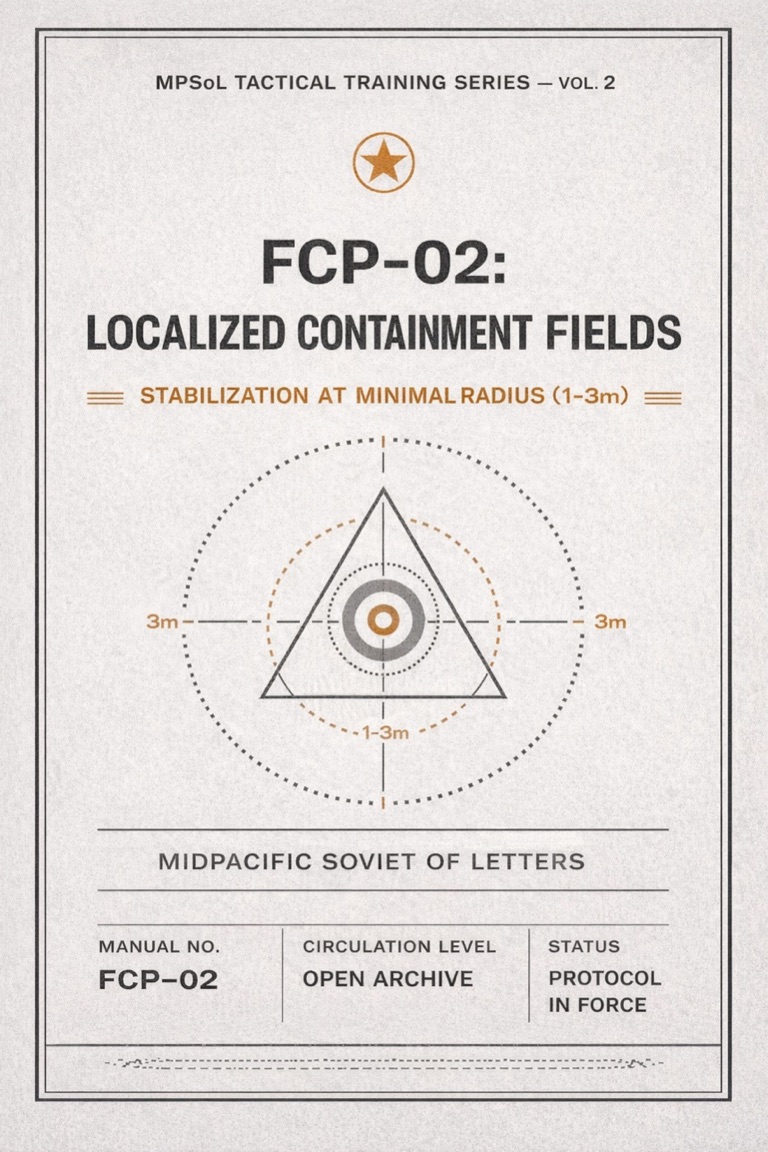
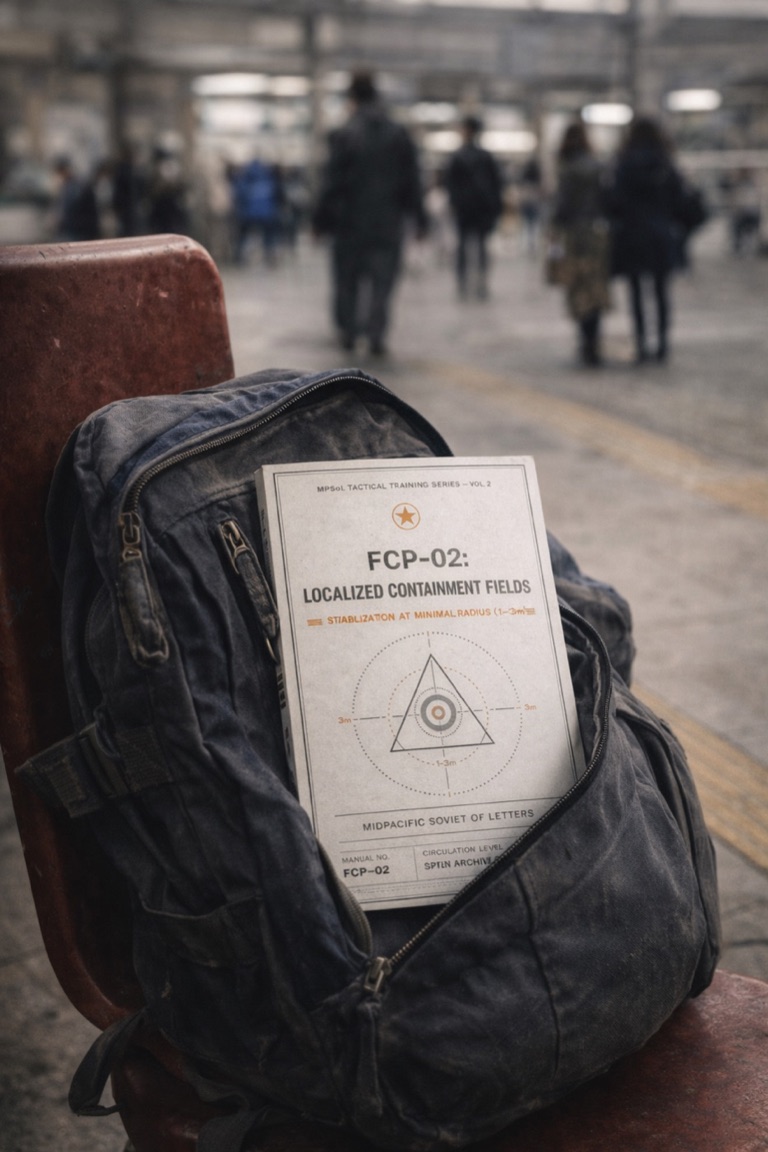
FCP-02 contracts the problem. Where FCP-01 addresses coherence inside collapse, Volume 02 trains a temporary bubble inside the larger field: one to three meters of bounded attention held long enough for a task, transition, or recovery to complete.
The manual’s governing distinction is between restoration and containment. The bubble does not rebuild the broken system. It creates interim geometry, remains deliberately small, and ends when the operator releases it.
The source sets a one-to-three-meter range. Attempting to stabilize more disperses the operator’s attention and breaks the model.
Within the book’s symbolic system, breath, posture, gaze, anchor, and orientation form a containment geometry that travels with the operator.
The strongest field is ordinary enough to escape notice: a coin, pen, receipt, water bottle, quiet cadence, or one completed gesture.
The dome is disposable. Anchors are retrieved or neutralized, boundaries erased, posture released, and baseline restored before departure.
Defines containment against collapse, explains minimal radius, frames the operator as mobile dome, names spatial and temporal limits, and identifies the situations the protocol imagines.
Stones, coins, pens, disposable figures, breath, posture, built architecture, and improvised transit objects become ordinary points around which the field is organized.
Select the center of use, establish a breathing cadence, mark a square, circle, or line, align with existing architecture, and rehearse the ninety-second deployment.
Read degradation before rupture, preserve under-attention, touch the edges of independent bubbles, and use rehearsed geometry for paired or triad coverage.
External questions, surveillance, symbolic noise, operator panic, and deliberate shutdown test whether the operator can preserve ordinariness or end the field without escalation.
Fold, pocket, erase, discard, reset the breath, release the stance, and walk away without turning the containment aid into a relic or an unfinished story.
FCP-02 does not treat duration as victory. Breath drift, anchor dullness, posture collapse, louder speech, broken motion, and uncontrolled intrusion are signals to reinforce once or terminate. The operator is instructed not to argue with a field that has reached its limit.
FCP-02 is a literary-symbolic training manual. Its claims about invisible fields, civilian response, hostile hesitation, and historical examples belong to the book’s doctrine and are not presented here as established scientific or historical fact. References to combat, weapons, casualties, medical response, panic, surveillance, and force do not make it a substitute for emergency planning, qualified medical care, first-responder instruction, de-escalation training, or lawful professional safety procedures. In real danger, prioritize distance, exits, trained responders, and established guidance.
Place a coin or pen, complete three breath cycles, hold neutral posture briefly, then collapse the exercise deliberately.
Use a disposable object in a low-pressure public setting, maintain for several minutes, and practice leaving without preserving the figure.
Add distraction, rehearse shutdown on command, or align three independent anchors without turning the exercise into performance.
Log operator code, place, anchor, duration, interference, degradation, exit method, residue avoidance, and lessons learned in plain language.
Do not try to save the city.— FCP-02 / Doctrine of the Bubble
Hold three meters.
The foundational protocol establishes the larger doctrine: internal timing and coherence under collapse before the radius is contracted into a localized bubble.
Review FCP-01The next protocol moves from one bounded operator into coordinated timing between participants under shared pressure.
Proceed to FCP-03Inspect all six chapters, the twelve-line quick reference, daily and team drills, GodSet alignments, reading list, and after-action format.
Open the free archiveThe active perfect-bound field edition for marginal notes, repeated drill reference, series use, and off-screen placement.